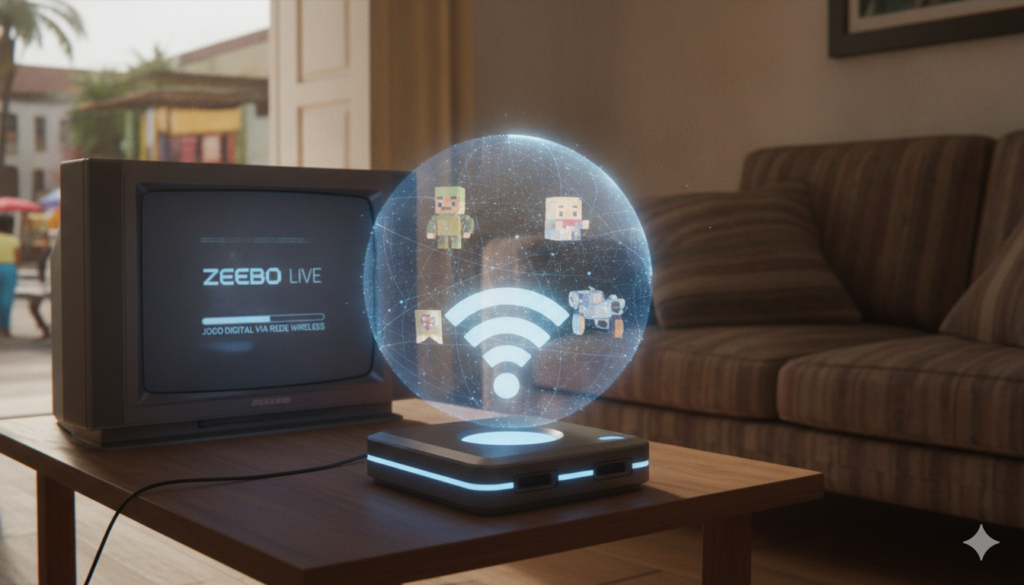

The world of video games is full of famous battles. We all know about Nintendo fighting Sega, or PlayStation taking on Xbox. But have you ever heard of the zeebo console? Released in 2009, this unique machine tried to change how people played games in developing countries like Brazil and Mexico. It was a home video game system built to fight piracy and offer cheap entertainment. Instead of using discs or cartridges, it relied entirely on a wireless network to deliver digital games. It was an incredibly smart idea that was simply way ahead of its time.
Looking back at gaming history, the zeebo console stands out as a brave experiment. The machine was created by a company called Tectoy along with Qualcomm. They wanted to reach millions of families who could not afford an expensive Xbox 360 or PlayStation 3. By using a free 3G cellular connection, players could download titles directly to their living room TV. Unfortunately, things did not go as planned. Let’s dive deep into the fascinating story, the strange technical specifications, and the ultimate downfall of this forgotten piece of history.
What Was the Zeebo Console?
The zeebo console was a seventh-generation home video game system designed for emerging markets. Unlike its giant competitors, this little white box did not have a disc drive. It relied 100% on digital downloads, which was a mind-blowing concept back in 2009. The creators wanted to make gaming accessible to people who had limited income and no home internet.
To make buying games easy, the system connected to a special cellular network called ZeeboNet. Players did not need a data plan or a monthly contract. The wireless connection was completely free to use. You simply turned on the machine, browsed the digital store, and bought games using prepaid credits. It was designed to bring affordable digital entertainment to the masses while completely stopping game piracy.
The Brilliant Anti-Piracy Strategy
In countries like Brazil during the late 2000s, video game piracy was a massive issue. Most physical stores sold cheap, bootleg discs because official games were heavily taxed and too expensive. The creators of the zeebo console realized they could solve this problem by eliminating physical media altogether. Without a disc tray or card slot, hackers had no easy way to load illegal software into the machine.
Every single game had to be downloaded directly through the secure wireless system. This gave game publishers a lot of confidence. Big industry names like EA, Capcom, and Activision agreed to support the platform because they knew their products could not be easily stolen. It was a clever business model that proved digital distribution could protect intellectual property in high-risk markets.
Technical Specifications and Hardware Secrets
When you look under the hood, the zeebo console was actually built using mobile phone technology. Instead of using standard computer chips, it used a Qualcomm processor meant for smartphones. This kept the manufacturing costs very low, but it also meant the system had very limited processing power.
The graphics chip was an ATI Imageon, which only allowed the system to output a maximum resolution of 640×480 pixels. It contained just 1 GB of internal flash memory for storing downloaded titles. While this sounds tiny today, most games back then only ranged from 5 MB to 25 MB in size.
The Complete Zeebo System Breakdown
To help you understand exactly what made this system tick, we have put together a detailed breakdown of its hardware and features. This shows how it compared to standard mobile phones and traditional home systems of the era.
System Specifications Table
| Hardware Component | Technical Specification | Practical Impact on Gaming |
| Main Processor | Qualcomm ARM11 (528 MHz) | Low power consumption but highly limited physics processing |
| Graphics Chip | ATI Imageon | Delivered simple 3D visuals similar to a classic PlayStation 1 |
| Internal Storage | 1 GB NAND Flash | Kept the price down but filled up fast with larger 50 MB games |
| Network Power | Built-in 3G / 2.5G GSM | Allowed free wireless downloads without needing home broadband |
| Video Output | RCA Composite Video | Connected easily to older CRT televisions common at the time |
| Controller Input | 6-Button Dual Analog | Provided a familiar layout for fans of classic arcade titles |
Bizarre Mobile Ports and the Game Library
Because the hardware was essentially a smartphone inside a plastic shell, the game library consisted mostly of modified mobile game ports. Developers took popular titles made for early mobile platforms and converted them to run on a television screen.
Players could enjoy interesting versions of famous hits like Resident Evil 4, FIFA 09, and Crash Bandicoot Nitro Kart 3D. The graphics looked quite basic compared to the beautiful high-definition visuals of the PS3. However, they were still fully playable 3D experiences. The system also offered emulated retro arcade classics like Double Dragon and Pac-Mania to appeal to older fans.
The Free Wireless Network Innovation
The true secret weapon of the zeebo console was the ZeeboNet wireless service. In 2009, setting up home internet in developing nations was slow, expensive, and required complex wiring. By partnering with local cellular networks, the creators bypassed this hurdle entirely.
As soon as a user plugged the machine into their TV, it was instantly online. You could download software seamlessly over the air. This was a massive advantage for families living in rural areas. It showed a deep understanding of infrastructure challenges, making the wireless downloading process completely stress-free for regular consumers.
Why the System Struggled to Survive
Despite the brilliant ideas behind the zeebo console, the hardware faced an uphill battle from day one. The biggest problem was the retail price. It was intended to be a budget machine, but high manufacturing costs meant it launched at around R$499 in Brazil.
For just a little bit more money, consumers could buy a modified PlayStation 2. The older PS2 had a massive library of thousands of legendary games available on cheap bootleg discs. Most parents chose the system with more games, even if it meant buying pirated copies. The budget-friendly white box simply could not compete with the sheer value of older, pirated home systems.
The Qualcomm BREW Development Problem
Another hidden issue was the software platform used to create the games. The system ran on a Qualcomm software framework called BREW. While BREW was fine for running basic apps on flip phones, it was never meant to act as a heavy-duty video game engine.
Game developers found the system incredibly difficult to work with. Porting large, complex games took a lot of effort and required heavy visual downgrades. Famous games like Sonic Adventure and Street Fighter Alpha were officially announced for the platform but had to be canceled because the software tools were just too limiting.
The End of the Wireless Dream
By 2011, the writing was on the wall for the ambitious project. The system never expanded past its trial runs in Brazil and Mexico, completely missing its planned launches in other major developing regions. Production was officially halted just two years after the initial release.
When the company shut down, the digital servers went offline too. Because the machine had no physical disc drive, users could no longer download any of their purchased software. If a system is cleared or reset today, it becomes completely empty. This tragic ending highlights the scary downside of a 100% digital future for media preservation.
The Modern Legacy of a Failed Pioneer
Even though the zeebo console was a commercial failure, its core concepts were completely correct. Today, every modern gaming machine relies heavily on digital stores, cloud downloads, and wireless updates. Systems like the Xbox Series S and the PlayStation 5 Digital Edition have completely abandoned physical discs.
The creators of this forgotten machine saw the digital future coming a whole decade before anyone else. They accurately predicted that physical media would eventually disappear. It serves as a fascinating reminder that being first to market with a futuristic idea does not always guarantee success if the technology is not quite ready.
Frequently Asked Questions
Can you still buy games on the Zeebo console today?
No, you cannot buy or download games anymore. The official wireless download network was permanently shut down in 2011. Since the system does not use discs, any unit found today can only play games that were already installed on its internal memory before the servers went offline.
What countries was the system officially released in?
The system was only officially launched and sold to the public in Brazil and Mexico. While there were initial plans to bring the hardware to other major emerging markets like India, China, and Russia, the project was canceled before those launches could take place.
Did the machine require a monthly internet subscription?
No, it did not require any monthly fees or internet contracts. The built-in cellular data connection was entirely free for the user. The data costs were covered through partnerships between the manufacturer and local mobile network operators.
How did players pay for their digital games?
Players purchased games using a virtual currency called Z-Credits. You could buy these credits online or purchase physical prepaid cards at local retail stores, similar to buying minutes for a prepaid mobile phone.
Why did the system use mobile phone chips instead of regular computer parts?
Using smartphone components allowed the company to keep the hardware affordable and energy-efficient. It also made it incredibly easy to port over existing mobile games, which kept software development quick and inexpensive.
Is there a way to emulate these games on a computer?
Yes, preservationists have been working hard on software emulation. A project called the Infuse emulator has successfully managed to run several titles on modern computers, ensuring that this unique piece of gaming history is not lost forever.
The Final Verdict on an Ambitious Experiment
The story of the zeebo console is a bittersweet tale of innovation. It tried to solve real-world problems like high prices and widespread piracy with a highly creative, forward-thinking solution. It proved that a digital-only wireless console could exist long before high-speed home broadband was common.
While it did not achieve the commercial success its creators hoped for, it earned a special place in the history of interactive entertainment. It remains an inspiring example of a company taking a massive risk to bring the joy of gaming to a brand-new audience. What do you think about this digital-only experiment? Let us know your thoughts!