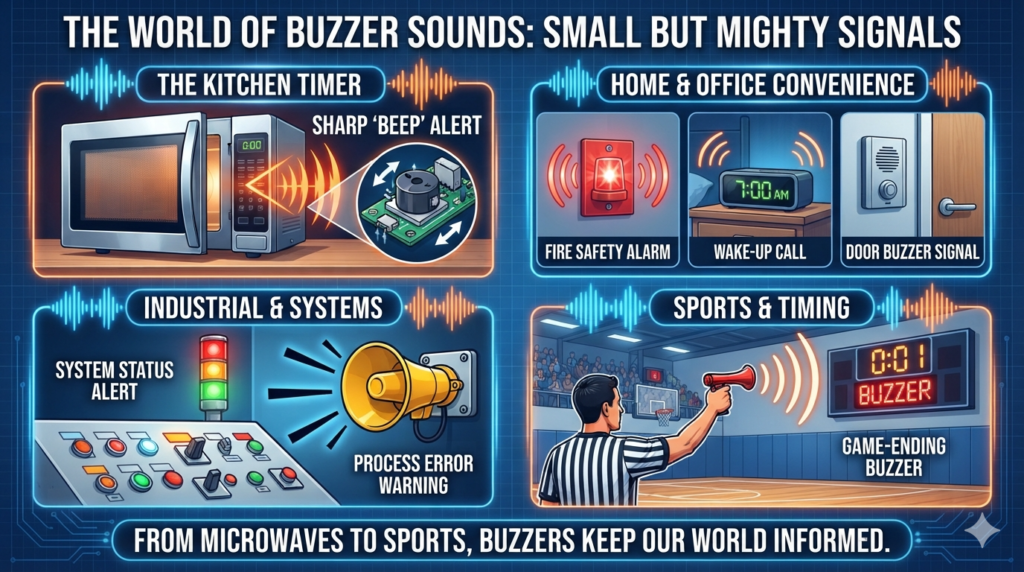

Have you ever wondered what makes that sharp “beep” in your microwave? That is a buzzer sound! These small but mighty devices are everywhere in our homes and offices. A buzzer sound is an audio signal made by an electronic or mechanical device. Whether it is a kitchen timer or a basketball game, these sounds help us know when something is happening. They are simple, but they play a big part in our daily lives. In this guide, we will explore everything about the buzzer sound and why it is so important.
What Exactly Is a Buzzer Sound?
A buzzer sound comes from a tool called an audio signaling device. People often call these buzzers or beepers. They can be very simple or quite complex depending on the design. Most of them turn electrical energy into a sound we can hear. You might hear a quick “click,” a long “buzz,” or a loud “beep.” These sounds are meant to grab our attention right away. Without the buzzer sound, many of our favorite gadgets would not be able to talk to us at all!
How Does a Buzzer Sound Get Created?
The secret behind a buzzer sound is usually vibration. Inside the device, electricity moves a small part back and forth very fast. This movement shakes the air around it, which creates the waves we hear as sound. Some buzzers use a thin piece of metal, while others use a special crystal. When the electricity stops, the movement stops, and the buzzer sound ends. It is a quick and efficient way to send an alert without needing a giant speaker or complex wires.
Different Types of Buzzers
There are many kinds of buzzers used for different tasks. The two most common types are active buzzers and passive buzzers. An active buzzer sound happens as soon as you connect it to a battery. It has a built-in circuit to make the tone. A passive buzzer sound needs a special signal to change the pitch. This allows it to play simple songs or melodies. Choosing the right one depends on whether you need a simple alert or something that can change its tone.
Piezoelectric Buzzers Explained
A piezo buzzer is a very popular type of device. It uses a piece of ceramic material to create a high-pitched buzzer sound. When you apply voltage, the material bends slightly. This bending action pushes the air to make sound. These are great for small electronics because they use very little power. You will often find a piezo buzzer sound inside toys, calculators, and medical devices. They are reliable and last a long time, making them a favorite for many engineers.
Magnetic Buzzers and Their Uses
Magnetic buzzers work in a slightly different way than piezo ones. They use an electromagnet to pull a metal disk and create a buzzer sound. This type often makes a louder, deeper noise. Because they use a coil, they are usually a bit bigger than other types. You might hear a magnetic buzzer sound in things like doorbells or car alarms. They are very effective when you need an alert that can be heard clearly across a room or even outdoors.
Common Uses for Buzzer Sounds
We use a buzzer sound for so many things every single day! One of the most famous uses is in a basketball game. When the clock runs out, the loud buzzer tells everyone the game is over. In our kitchens, a buzzer sound tells us our food is ready. They are also used in schools for bells and in offices for door buzzers. These sounds keep us on time and help us stay safe by alerting us to important changes.
Buzzers in Electronics and Robotics
If you are learning about electronics, a buzzer is a great first project. You can easily connect a buzzer sound module to a small computer board like an Arduino. This lets you code your own alerts. You could make a alarm for your room or a sensor that buzzes when someone gets close. Learning how to create a buzzer sound is a fun way to understand how electricity turns into noise. It is a classic skill for any young inventor or tech fan.
Comparing Mechanical and Electronic Buzzers
In the old days, a buzzer sound was made using purely mechanical parts. Think of an old-fashioned doorbell or a bicycle bell. These were simple but strong. Today, we mostly use electronic buzzers because they are smaller and more flexible. An electronic buzzer sound can be programmed to beep faster or slower. While mechanical buzzers are still used for some things, electronic ones have changed how we design almost every modern gadget we use.
Why We Use Buzzers Instead of Speakers
You might ask why we use a buzzer instead of just a regular speaker. The answer is simple: size and cost! A speaker is great for music, but it is too big for a simple alert. A buzzer sound is meant to be a simple signal, not a high-quality audio experience. Buzzers are also very cheap to make. They do one job—making a clear, urgent buzzer sound—and they do it better than almost any other device in our electronics.
Detailed Comparison Table
| Feature | Piezo Buzzer | Magnetic Buzzer |
| Sound Quality | High-pitched/Sharp | Deeper/Loud |
| Power Needed | Very Low | Higher |
| Best Used For | Small Toys, Alarms | Doorbells, Car Alerts |
| Size | Very Small | Medium |
| Main Component | Ceramic Disk | Coil and Magnet |
Frequently Asked Questions
1. Can a buzzer play real music?
Yes, a passive buzzer can play simple melodies if you send it the right signals!
2. Is a doorbell a type of buzzer?
Many doorbells use a buzzer mechanism to create that classic sound when you press the button.
3. Why does my microwave make a buzzing noise?
That is an electronic buzzer inside designed to alert you when your food is done cooking.
4. What is the difference between an active and passive buzzer?
An active buzzer makes sound with just power; a passive one needs a signal to control the tone.
5. Are buzzers dangerous?
No, they are very safe! They are low-voltage components used in almost every household electronic device.
6. Can I change the volume of a buzzer sound?
It is hard to change the volume, but you can change the tone or how often it beeps.
Conclusion
The buzzer sound is truly a hidden hero of the modern world. From the simple beep of your watch to the final buzzer at a big game, these devices keep us informed. Now that you know how they work and the different types available, you can appreciate them a bit more. Next time you hear one, listen closely to the sound it makes! Do you have a favorite project where you could use a buzzer? Try building one yourself and see how it works!