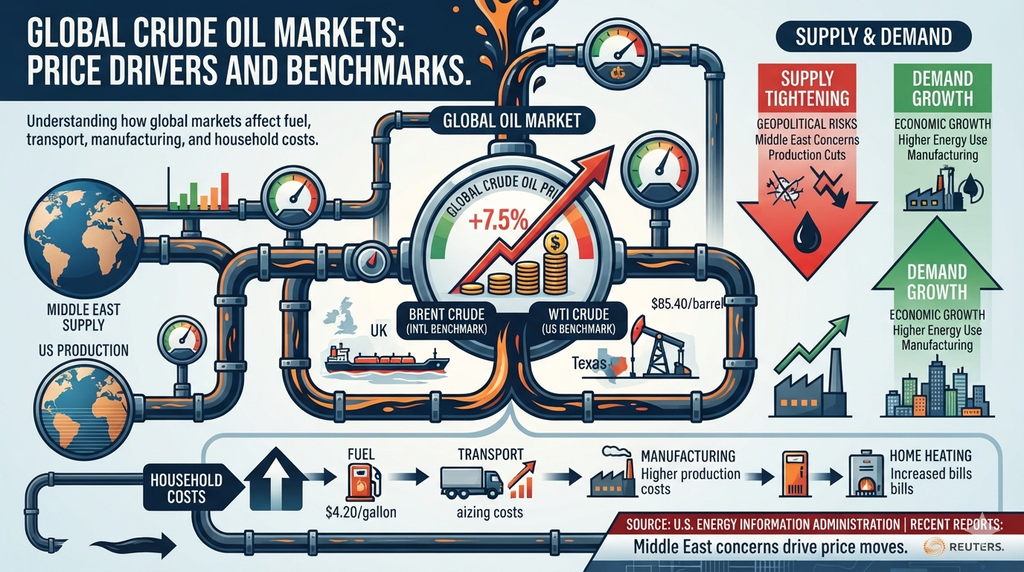

The oil price shows how much buyers pay for crude oil in global markets. It affects fuel, transport, manufacturing, and many household costs. Crude oil is traded around the world, so prices can change quickly. Two important benchmarks are Brent crude and West Texas Intermediate, or WTI. Brent is widely used for international pricing. WTI is a major benchmark for the United States. Prices can rise when supply becomes tight. They can fall when supply grows faster than demand. Economic growth also matters because stronger economies often use more energy. The U.S. Energy Information Administration explains that global supply and demand are central drivers of crude prices. Today, oil markets are also watching geopolitical risks closely. Recent reports show Brent and WTI have moved sharply as Middle East supply concerns increased.
Oil Price Today: What Is Happening?
The oil price market remains highly volatile in October 2026. Recent trading has been shaped by Middle East security risks and concerns about supply routes. Reuters reported on October 21 that Brent crude rose to about $110.40 per barrel. WTI increased to about $99.27 per barrel.These figures can change throughout the trading day. Futures prices also differ based on delivery months. This is why readers should check live market data before making financial decisions. The recent movement shows how quickly sentiment can change. Oil traders watch shipping routes, production levels, inventories, and diplomatic news. Even small changes can affect expectations. The Strait of Hormuz is especially important because disruptions there can affect global energy flows. Current market conditions therefore require careful attention. A single daily price does not tell the entire story.
Brent Crude and WTI Explained
Brent and WTI are the two names most people see when following the oil price. Brent is the main international benchmark. It reflects crude grades linked to production and trading around the North Sea. WTI is associated mainly with the U.S. market. It is known for its high quality and low sulfur content. The two benchmarks often move in the same direction. However, their prices can differ. Transport costs, regional supply, storage, refinery demand, and market conditions can create a spread. Investors should also understand the difference between spot prices and futures contracts. A spot price relates closely to current delivery. Futures contracts represent agreed prices for future delivery. These details matter when reading financial news. A headline may mention one benchmark while another moves differently. Understanding the benchmark helps readers avoid confusion and interpret market reports more clearly.
Main Factors That Move Oil Prices
Several forces can change the oil price within hours or days. Supply is one of the biggest factors. Production cuts can reduce available barrels and support higher prices. Increased production can have the opposite effect. Demand is another major force. Strong economic activity can increase fuel consumption. Weak growth can reduce energy use. Geopolitical events can also create sudden market reactions. Wars, sanctions, shipping disruptions, and political disputes may raise supply concerns. Currency movements matter too. Crude is generally priced in U.S. dollars. Changes in the dollar can influence purchasing power for international buyers. Weather can also affect production, transportation, and refinery operations. Investors therefore follow many data points at once. The EIA notes that economic growth, OPEC decisions, non-OPEC supply, and consumer behavior all influence crude markets.
How Supply and Demand Affect Oil
The basic relationship between supply and demand remains central to the oil price. Imagine a market with fewer barrels but unchanged demand. Buyers may compete more aggressively for available supplies. Prices can then rise. The opposite can happen when production increases while demand stays weak. More available crude can place downward pressure on prices. However, the real market is more complex. Oil cannot always move instantly from one location to another. Pipelines, ports, tankers, refineries, and storage facilities all matter. This creates regional differences. Demand also changes with economic conditions. Airlines, factories, trucks, cars, and ships all consume petroleum products. A slowdown can reduce consumption. A recovery can increase it. The International Energy Agency has recently highlighted major changes in both supply and demand forecasts for 2026. This shows why oil markets must be viewed globally.
The Role of OPEC in Oil Markets
OPEC has a major role in the oil price because its members produce a large share of global crude. The organization can influence supply through production targets. OPEC+ decisions are also closely watched by traders and analysts. When major producers announce output cuts, markets may expect tighter supply. Prices can respond quickly. When production increases, expectations can change again. However, OPEC does not control every barrel in the world. Non-OPEC producers, including the United States and other major producers, also affect supply. The EIA notes that OPEC’s influence depends on factors such as quota compliance, consumer response, and competition from non-OPEC producers. This makes the market more dynamic. Traders must look beyond official announcements. Actual production, exports, inventories, and refinery demand can provide important clues about the real market balance.
Why Oil Inventories Matter
Oil inventories can strongly influence the oil price because they show how much crude and petroleum products are stored. When inventories rise, markets may see more available supply. That can reduce price pressure if demand remains weak. When inventories fall, concerns about tight supply may increase. The EIA describes inventories as an important balancing point between supply and demand. Traders watch U.S. crude stocks particularly closely. They also monitor gasoline and distillate inventories. These figures can provide clues about refinery activity and consumer demand. Inventory data can sometimes surprise the market. A larger-than-expected draw may support prices. A large build may pressure them. However, inventory numbers should not be viewed alone. Seasonal patterns, imports, exports, refinery maintenance, and production changes can all affect weekly data. A broader trend usually gives a better picture than one report.
Geopolitical Risks and Oil Prices
Geopolitical risk can move the oil price very quickly. Oil production is concentrated in several important regions. Major shipping routes are also critical to global trade. Any threat to production or transportation can create a risk premium. Recent October 2026 trading shows this clearly. Reports have linked higher crude prices with renewed concerns around the Middle East and shipping security. The Strait of Hormuz is especially important because large volumes of energy products pass through the wider Gulf region. Markets can react even before physical supply is disrupted. Traders price in possible future shortages. At the same time, diplomatic progress can quickly reduce that premium. This explains why oil can rise sharply one day and fall the next. Political developments should therefore be considered alongside production and demand data.
Oil Prices and Inflation
Changes in the oil price can affect inflation because petroleum products are used across the economy. Higher crude costs can increase gasoline and diesel prices. Transport companies may then face higher operating costs. Those costs can spread through supply chains. Businesses may pay more to move goods and operate machinery. Airlines can also face higher fuel expenses. Consumers may eventually see higher prices for some products. The impact is not always immediate. It depends on refining margins, taxes, currency movements, transportation costs, and local market conditions. Lower crude prices can reduce some of these pressures. However, retail fuel prices may not fall at the same speed. This is because different markets have different pricing systems. Oil is therefore an important part of the wider inflation picture. Central banks and governments often monitor energy prices when assessing economic conditions.
Oil Prices and the Global Economy
The oil price has a close connection with global economic growth. Oil is used in transportation, industry, construction, farming, and manufacturing. Higher prices can raise costs for companies that depend heavily on fuel. That may reduce profits or increase consumer prices. Lower prices can provide relief for many businesses and households. However, oil producers may earn less revenue when prices fall. This can affect investment in new production. The International Energy Agency’s October 2026 report expects global oil demand to remain under pressure this year. This highlights the complicated relationship between energy and economic growth. A strong economy can support oil demand. Yet very high prices can eventually weaken that demand. The result is a constant balancing process. Investors therefore watch economic data, industrial activity, transportation demand, and energy consumption together.
Oil Price Forecast: What Could Happen Next?
Predicting the future oil price is difficult because many variables can change quickly. Analysts typically study supply, demand, inventories, production, economic growth, and geopolitical conditions. Current conditions suggest that risk remains elevated. Recent market reports show Brent trading around the $110 area and WTI around the $100 area. Yet these levels should not be treated as guaranteed future prices. Diplomatic progress could reduce geopolitical risk. New supply could also ease pressure. Conversely, a major disruption could push prices higher. The IEA’s October report also points to weaker global demand in 2026.This creates an important counterweight to supply concerns. Forecasts are therefore best viewed as scenarios rather than promises. Anyone making financial decisions should consider several outcomes and avoid relying on one prediction.
Oil Price Trends to Watch
| Market Factor | Possible Effect on Oil | What to Watch |
|---|---|---|
| Global demand | Higher demand can support prices | Economic growth |
| OPEC production | Lower output can support prices | Production targets |
| U.S. production | More supply can pressure prices | Drilling and output |
| Oil inventories | Falling stocks can support prices | Weekly inventory reports |
| Geopolitical risk | Disruption fears can lift prices | Conflicts and sanctions |
| Shipping routes | Disruptions can tighten supply | Tanker traffic |
| Refinery demand | Strong activity can increase crude demand | Refinery utilization |
| U.S. dollar | Currency changes can affect crude demand | Dollar index |
| Economic slowdown | Lower demand can pressure prices | GDP and industrial data |
| Energy policy | Policy shifts can change demand | Government decisions |
This table provides a simple framework for understanding the market. No single factor controls crude prices. Instead, several forces interact at the same time. EIA analysis confirms that supply, demand, inventories, OPEC decisions, and non-OPEC production all matter.
How Consumers Are Affected by Oil Prices
Changes in the oil price can reach consumers through several channels. The most obvious example is fuel. Higher crude costs can contribute to higher gasoline and diesel prices. Transportation companies may also increase charges when fuel becomes more expensive. This can affect deliveries and other services. Households may notice changes at fuel stations first. The wider effects can take longer to appear. Airlines, shipping firms, factories, and farmers also use petroleum products. Their costs can influence the final price of goods. However, crude oil is only one part of the final retail price. Taxes, refining costs, distribution expenses, and local market conditions also matter. This is why a large crude move does not always create an identical move at the pump. Understanding this difference helps consumers interpret energy news more accurately.
Oil Prices and Energy Alternatives
The long-term oil price story also connects with renewable energy and electric vehicles. Solar power, wind energy, batteries, and electric vehicles can reduce oil demand in some areas. Yet the transition takes time. Oil remains important for aviation, shipping, chemicals, heavy transport, and many industrial uses. Petrochemicals also require hydrocarbons for products such as plastics and other materials. This means oil demand can change even while energy systems become cleaner. Investment decisions are another important factor. Very low crude prices may reduce incentives for expensive new production. Very high prices can encourage producers to invest in alternatives and efficiency. The energy system is therefore changing gradually. Investors and businesses need to consider both current market conditions and long-term structural trends. A single year’s price does not define the future of global energy.
How to Follow Oil Prices Responsibly
Anyone following the oil price should use reliable sources and avoid reacting to headlines alone. Start by checking Brent and WTI benchmarks. Then review the latest supply and demand information. Inventory reports can provide useful short-term clues. OPEC announcements can influence expectations. Government and international energy agencies can offer broader analysis. The EIA provides detailed information about oil prices and market fundamentals. The IEA also publishes regular oil market reports covering demand, supply, inventories, refining, and trade.It is also important to understand volatility. Oil can move sharply after unexpected news. Readers should avoid assuming that yesterday’s trend will continue today. If oil information is being used for investment decisions, independent financial advice may be appropriate. Good research begins with reliable data and balanced expectations.
Frequently Asked Questions About Oil Price
What is the current oil price?
The current oil price changes throughout the trading session. On October 21, 2026, Reuters reported Brent near $110.40 per barrel and WTI near $99.27. Prices can change quickly, so live market data is best for real-time figures.
Why is oil so volatile?
Oil is volatile because supply and demand can change quickly. Geopolitical events can also create sudden supply concerns. Shipping problems, production changes, inventory reports, and economic data can move prices.
What is the difference between Brent and WTI?
Brent is a major international crude benchmark. WTI is a major U.S. benchmark. Both are widely followed, but their prices can differ because of regional market conditions, transportation, storage, and supply factors.
Does OPEC control oil prices?
OPEC does not completely control prices. It can influence supply through production targets. Non-OPEC producers, consumer demand, inventories, and geopolitical events also have major effects.
Do higher oil prices cause higher inflation?
Higher crude prices can contribute to inflation. Fuel and transportation costs may rise. Businesses can then face higher operating expenses. However, the final effect depends on many other economic factors.
Will oil prices rise or fall in the future?
No forecast can guarantee the future direction. Current prices reflect supply concerns and geopolitical risks. Meanwhile, weaker demand forecasts could create downward pressure. The balance between these forces will remain important.
Conclusion: Understanding the Oil Market
The oil price remains one of the most important indicators in the global economy. It affects fuel, transportation, industry, inflation, and financial markets. Brent and WTI provide useful benchmarks for understanding crude movements. Supply, demand, OPEC decisions, inventories, economic growth, and geopolitical events all influence prices. Current October 2026 conditions show how quickly the market can change. Recent Middle East tensions have pushed prices higher while demand concerns create a competing pressure. The best approach is to look beyond one headline or one day’s movement. Follow reliable data and compare several market signals. That approach can provide a clearer view of where the energy market stands. For readers, businesses, and investors, understanding these fundamentals is more useful than simply guessing the next price move.